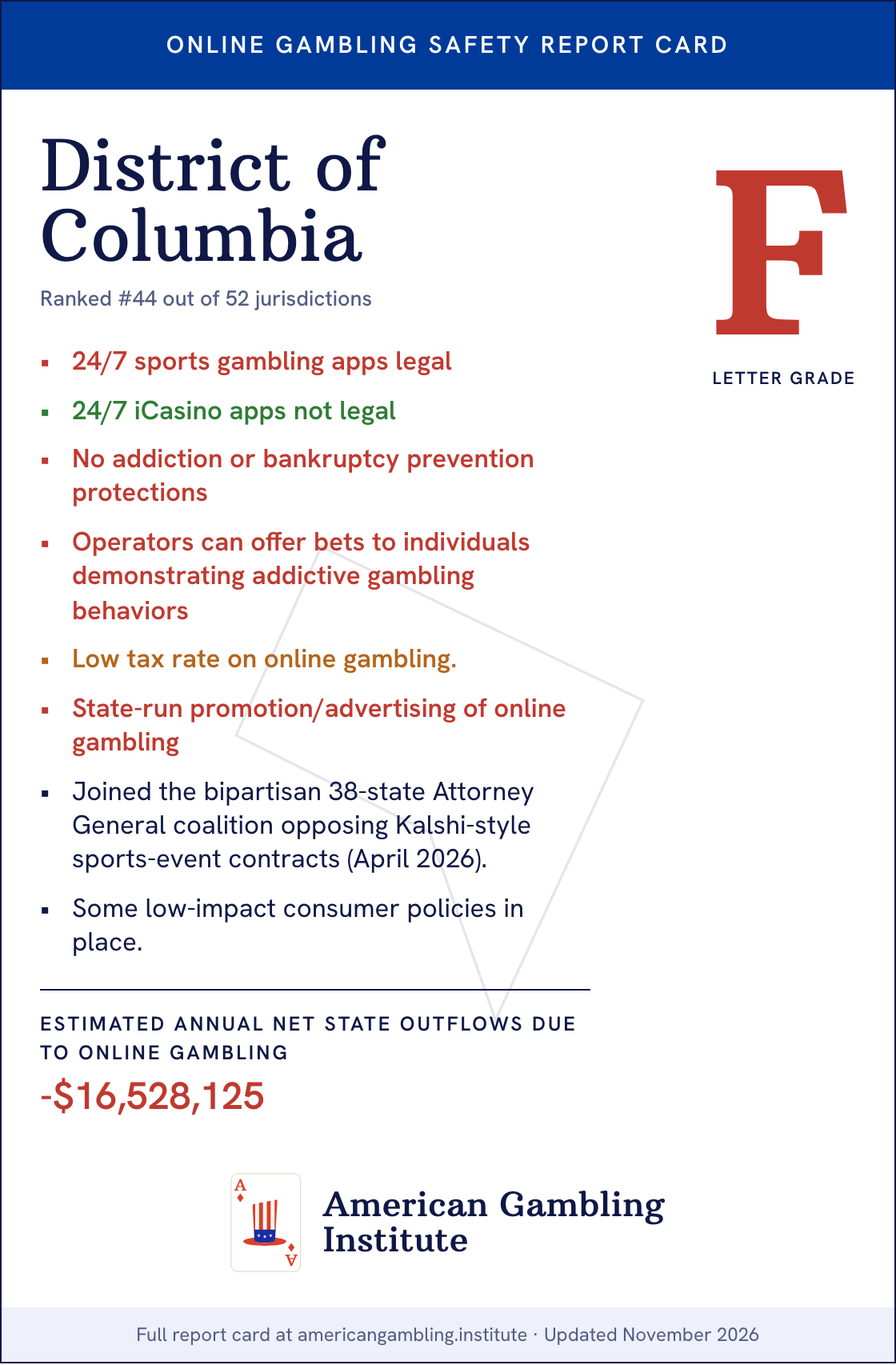
District of Columbia
Ranked #44 out of 52 jurisdictions
- 24/7 sports gambling apps legal
- 24/7 iCasino apps not legal
- No addiction or bankruptcy prevention protections
- Operators can offer bets to individuals demonstrating addictive gambling behaviors
- Low tax rate on online gambling.
- State-run promotion/advertising of online gambling
- Joined the bipartisan 38-state Attorney General coalition opposing Kalshi-style sports-event contracts (April 2026).
- Some low-impact consumer policies in place.
Institute
District of Columbia
DCScore: 41 / 100
A+=100+ · A=90–99 · B=80–89 · C=70–79 · D=50–69 · F=30–49 · F−=0–29
40 + 0 + 0 + 8 + 1 + 0 − 8
- 24/7 sports gambling apps legal
- 24/7 iCasino apps not legal
- No addiction or bankruptcy prevention protections
- Operators can offer bets to individuals demonstrating addictive gambling behaviors
- Low tax rate on online gambling.
- State-run promotion/advertising of online gambling
- Joined the bipartisan 38-state Attorney General coalition opposing Kalshi-style sports-event contracts (April 2026).
- Some low-impact consumer policies in place.
| Legal status | Notes & sources | |
|---|---|---|
| Online sports betting | Legal |
|
| iCasino (online casino-style games) | Not legal |
|
| Minimum age (sports betting) | 18+ |
|
Online gambling apps route losses to out-of-state operators and vendors, creating large net leakages from state economies and reduced in-state spending by residents, even after deducting retained state taxes and activity from in-state app operations.
Model: gambling-flows (mid scenario, 2025; source data 2026-10-12).
- When betting apps were legalized/launched (sports betting): online + retail launch: May 28, 2020.
- Main legal model / provisions (sports betting): The District-operated GambetDC sportsbook launched on May 28, 2020. A 2024 law expanded mobile and online wagering through Class A and new Class C licenses while retaining the retailer and kiosk program.
- Online casino / iCasino: Not legal.
- Score-relevant protections observed here: Problem gambling hotline (+2), Funding for problem gambling messaging (+2), Non-integrated Self-exclusion list (+2), Close the Kalshi “investment contract” loophole (+2)
- July 15, 2024 — Enacted: The Sports Wagering Amendment Act of 2024 took effect, allowing Class A licenses to operate mobile and online wagering, creating Class C licenses for eligible sports teams and commercial partners, and setting a new license-class tax structu…
- Office of Lottery and Gaming. Public Oversight Hearing on Performance Oversight of the Office of Lottery and Gaming (Office of the Chief Financial Officer, 2022-03-04). Accessed 2026-11-07.
- Government of the District of Columbia. Sports Wagering Tax (Office of Tax and Revenue). Accessed 2026-11-07.
- Council of the District of Columbia. D.C. Law 25-217. Fiscal Year 2025 Budget Support Act of 2024. (D.C. Law Library, 2024-07-15). Accessed 2026-11-07.
score = policyPoints + protectionsPoints + taxPoints + agePoints − promotionPenalty
(40 + 0 + 0) + 8 + 1 + 0 − 8 = 41
Safety Scoring
Scoring methodology and formula.
Online sports betting apps are legal.
- Government of the District of Columbia. Sports Wagering Tax (Office of Tax and Revenue). Accessed 2026-11-07.
- Council of the District of Columbia. D.C. Law 25-217. Fiscal Year 2025 Budget Support Act of 2024. (D.C. Law Library, 2024-07-15). Accessed 2026-11-07.
iCasino apps are not legal.
- Government of the District of Columbia. Sports Wagering Tax (Office of Tax and Revenue). Accessed 2026-11-07.
- Council of the District of Columbia. D.C. Law 25-217. Fiscal Year 2025 Budget Support Act of 2024. (D.C. Law Library, 2024-07-15). Accessed 2026-11-07.
Bonus not awarded — at least one form of online gambling is legal in this state.
- Government of the District of Columbia. Sports Wagering Tax (Office of Tax and Revenue). Accessed 2026-11-07.
- Council of the District of Columbia. D.C. Law 25-217. Fiscal Year 2025 Budget Support Act of 2024. (D.C. Law Library, 2024-07-15). Accessed 2026-11-07.
- Office of Lottery and Gaming. Sports Betting (D.C. Lottery). Accessed 2026-11-07.
- Office of Lottery and Gaming. Public Oversight Hearing on Performance Oversight of the Office of Lottery and Gaming (Office of the Chief Financial Officer, 2022-03-04). Accessed 2026-11-07.
Statutory tax rate (sports betting operators): Online 20% (Class A); Class B 10%; Class C 30%
- Effective August 1, 2024, Class A operators pay 20% of gross sports wagering revenue, Class B operators 10%, and Class C operators 30%.
- Rate depends on license class.
- Class A and Class C licenses may offer mobile or online wagering.
- Government of the District of Columbia. Sports Wagering Tax (Office of Tax and Revenue). Accessed 2026-11-07.
- Council of the District of Columbia. D.C. Law 25-217. Fiscal Year 2025 Budget Support Act of 2024. (D.C. Law Library, 2024-07-15). Accessed 2026-11-07.
0 points for 18+, 2 points for 21+, 5 points for 25+.
- Government of the District of Columbia. Final Rulemaking: Sports Wagering (Alcoholic Beverage and Cannabis Administration, 2019-08-30). Accessed 2026-11-07.
Bans using credit cards to fund online betting.
Publicly advertised problem-gambling hotline/helpline (and referral to support resources). This is a low-efficacy intervention.
- National Council on Problem Gambling. About the National Problem Gambling Helpline™ (National Council on Problem Gambling (NCPG), 2023-11-22). Accessed 2026-11-07.
- National Council on Problem Gambling. District Of Columbia Problem Gambling Resources (National Council on Problem Gambling, 2023-11-20). Accessed 2026-11-07.
Earmarks funds for problem gambling education/public-awareness messaging (not just voluntary operator messaging). This is typically small and often poorly executed.
- National Association of Administrators for Disordered Gambling Services. District of Columbia - NAADGS (NAADGS, 2020-01-07). Accessed 2026-11-07.
- Government of the District of Columbia. Final Rulemaking: Sports Wagering (Alcoholic Beverage and Cannabis Administration, 2019-08-30). Accessed 2026-11-07.
State provides a self-exclusion program (ideally centralized across licensed operators). This is a low-efficacy tool when not integrated into the gambling user flow.
- Government of the District of Columbia. Final Rulemaking: Sports Wagering (Alcoholic Beverage and Cannabis Administration, 2019-08-30). Accessed 2026-11-07.
Mandatory, enforceable, cross-operator loss limits that cap how much a person can lose in a time period (e.g., monthly). Highly effective for preventing bankruptcies.
Bans or tightly limits promotional inducements (bonuses, risk-free bets, boosted odds) used to accelerate losses.
Prohibits in-game/live betting so wagers can only be placed before events begin.
Requires operators to stop offering bets when users exhibit defined high-risk patterns (not merely provide links to a hotline).
Requires explicit spousal consent before connecting or using a shared/joint bank account for gambling.
Requires players to set limits at signup (or imposes defaults) rather than burying optional limit-setting tools.
Imposes a mandatory waiting period between deposits and wagering to reduce compulsive 'tilt' behavior.
Imposes meaningful limits on gambling advertising (e.g., time/place bans, tobacco-style warnings) beyond generic 'gamble responsibly' language.
Removes gambling apps from app stores, where the easy access and notification systems increase addictive patterns. In states with legal online gambling, these services would remain available on websites.
Requires public reporting on operator harm indicators (e.g., share of revenue from high-risk users, intervention rates), enabling oversight.
State action to block sports event contracts marketed as federally regulated derivatives. Joining the multi-state attorney general coalition (38 AGs as of the April 2026 Massachusetts brief) earns 2 points; cease-and-desist earns 4; court action earns 8 (max 8).
- Yost Co-leads Bipartisan Coalition Targeting Gambling Loophole - Ohio Attorney General Dave Yost (ohioattorneygeneral.gov). Accessed 2026-11-07.
- Attorney General James Joins Bipartisan Coalition Defending States’ Gambling Laws Against Prediction Markets (New York State Attorney General, 2026-05-29). Accessed 2026-11-07.